
A tiny house can be the perfect blend of affordability, simplicity, and freedom, but none of that matters if it’s sitting on the wrong foundation. The base you choose affects everything from legal status and resale value to structural integrity and how long your build can stay put. Whether someone’s planning a mobile dwelling on a trailer, a semi-permanent skid system, or a code-compliant slab, the foundation decision shapes costs, permits, and long-term livability. This guide walks through every major foundation type for tiny houses in 2026, from poured concrete to trailer frames, so builders can match their base to their goals, budget, and site conditions.
Table of Contents
ToggleKey Takeaways
- Your tiny house foundation type determines legal status, financing options, and resale value—permanent foundations like slabs and piers enable conventional mortgages, while trailer bases preserve mobility but limit parking locations.
- Concrete slabs and pier-and-beam foundations are the most code-compliant permanent options, with slabs costing $3,000–$8,000 and lasting 50+ years, though they lock structures in place permanently.
- Trailer-based tiny houses offer relocatable flexibility for $1,500–$5,000 but typically fall under RV regulations, making full-time occupancy harder to finance and insure than permanent foundations.
- Skid and post foundations provide budget-friendly semi-permanent alternatives under $1,500 that work well on sloped terrain and rural properties, though they may not meet building codes for permanent occupancy.
- Site conditions, local zoning laws, and intended permanence should guide your foundation choice—verify regulations with your local building department before committing to avoid costly legal and structural issues.
- Soil testing, frost depth research, and structural engineering consultation prevent expensive mistakes in foundation design and ensure your tiny house foundation can safely distribute weight and resist environmental stresses.
Why Your Foundation Choice Matters for Tiny House Success
Foundation selection isn’t just about keeping walls level, it determines whether a tiny house qualifies as real property or personal property, which affects financing, insurance, and zoning compliance. Permanent foundations like slabs or piers typically meet building codes for residential structures, opening doors to conventional mortgages and lower insurance premiums. Trailer-based builds, by contrast, often fall under RV or mobile home regulations, which can limit where they’re legally parked but preserve mobility.
Structural performance hinges on the foundation, too. A poorly chosen or under-engineered base leads to differential settlement, cracked framing, binding doors, and moisture intrusion. Tiny houses pack full-size loads, plumbing, appliances, people, into compact footprints, so the foundation must distribute weight evenly and resist frost heave, soil expansion, and wind uplift. Skipping proper planning here means expensive repairs or even a total rebuild.
Cost and timeline vary dramatically. Pouring a slab with footings might run $3,000–$8,000 depending on region and site prep, while a used trailer frame can start around $1,500. Permitting and inspections add weeks to permanent foundations, but they also future-proof the investment. Builders who match foundation type to intended use, weekend retreat, full-time residence, rental unit, save money and headaches down the road.
Permanent Foundation Options: Stability and Long-Term Value
Permanent foundations anchor a tiny house to real property, meeting most residential building codes and enabling mortgage financing. They’re the go-to for anyone planning to stay put long-term or who needs to satisfy local zoning ordinances that prohibit mobile structures.
Concrete Slab and Pier Foundations
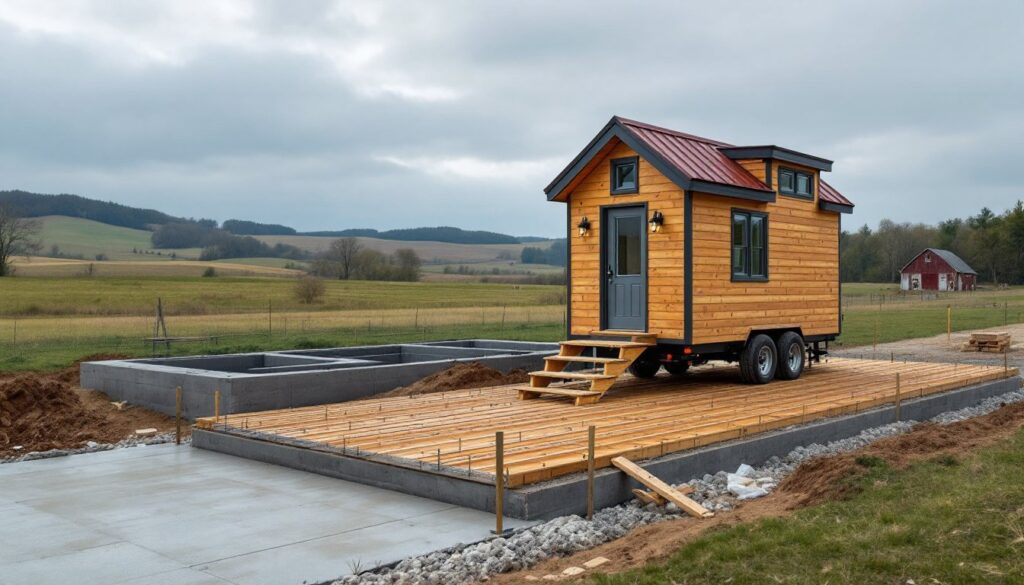
Concrete slabs are the most common permanent foundation for tiny houses. A typical 4-inch monolithic slab with turned-down edges (thickened perimeter footings) works for frost-protected shallow foundations in milder climates, while colder regions require footings below the frost line, often 36 to 48 inches deep depending on jurisdiction. The slab acts as both foundation and subfloor, simplifying framing and providing a thermal mass that moderates indoor temperatures.
Pros: durable, termite-resistant, and code-compliant nearly everywhere. A well-poured slab can last 50+ years with minimal maintenance. Cons: site prep (excavation, compacted gravel base, vapor barrier, and reinforcement mesh or rebar) adds cost and time. Slabs also lock the structure in place, relocation isn’t an option without demolition.
Pier-and-beam foundations (also called post-and-pier) elevate the tiny house on a grid of concrete piers or sonotube footings, with a wooden beam or steel I-beam frame supporting the floor joists. Piers typically sit 12 to 16 inches in diameter, extend below frost line, and space 6 to 8 feet on center depending on load calculations. This system excels on sloped sites and in flood-prone areas, keeping the structure above grade and allowing drainage underneath. Builders using professional tiny house designs often specify pier systems for challenging terrain.
Pros: excellent ventilation under the floor, easier utility runs, and adaptable to uneven ground. Cons: requires precise leveling, more labor than a slab, and the crawl space needs vapor barriers and venting to prevent moisture problems. Pest screens and skirting are essential to keep critters out.
Both slab and pier foundations require building permits and inspections, which vary by county. Expect to submit engineered drawings showing load paths, rebar schedules, and frost protection details. If the tiny house will connect to municipal water and sewer, the foundation must accommodate those penetrations during the pour or beam layout.
Trailer Foundations: Mobility Meets Flexibility
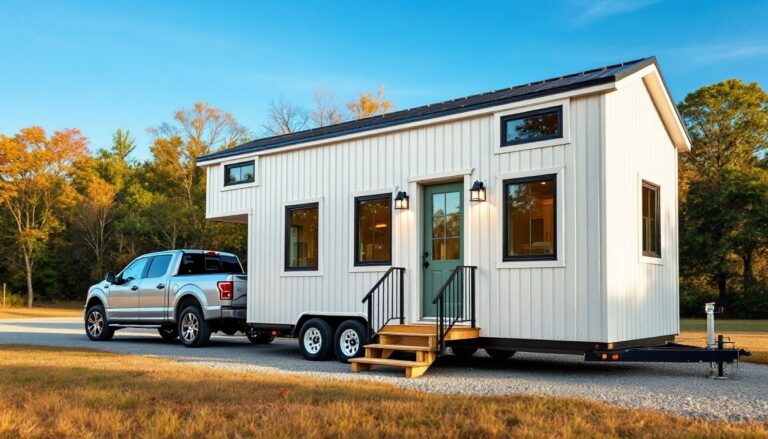
Trailer foundations turn a tiny house into a towable dwelling, preserving the freedom to relocate without disassembly. This approach appeals to those seeking flexibility in finding suitable parking or avoiding restrictive residential zoning.
Most tiny house trailers are heavy-duty flatbed or gooseneck trailers rated for 10,000 to 14,000 pounds GVWR (gross vehicle weight rating). Frame construction typically uses steel I-beams or rectangular tube steel with crossmembers every 16 to 24 inches to support floor joists. Reputable builders source trailers specifically engineered for dwelling loads, standard utility trailers lack the frame strength and axle capacity for a finished house.
Width is a critical constraint. Trailers 8.5 feet wide travel without oversize permits in most states, while anything wider requires route permits, escort vehicles, and restrictions on travel times. Length usually caps at 20 to 28 feet for single-axle or tandem-axle configurations: longer builds need triple axles and more complex hitching.
Builders must account for road dynamics: flexing, vibration, and lateral forces that never affect stationary foundations. Structural sheathing (typically 3/4-inch plywood or OSB) glued and screwed to the frame creates a stressed-skin panel that resists racking. Wall framing uses metal hurricane ties and Simpson Strong-Tie connectors to anchor studs to the floor deck and top plates to rafters. Skipping these details leads to cracked drywall, popped fasteners, and even structural failure during transport.
Trailer foundations usually don’t require building permits, falling instead under DMV and DOT regulations. But, many jurisdictions treat parked tiny houses on trailers as RVs, limiting occupancy to campgrounds, RV parks, or properties with specific variances. Insurance often classifies them as mobile homes, which can be harder to insure than real property. Anyone planning full-time occupancy should verify local rules before committing to a trailer base.
Skid and Post Foundations: Budget-Friendly Alternatives
Skid foundations sit between trailers and permanent systems, semi-permanent, relocatable with heavy equipment, and often exempt from full building permits in rural jurisdictions. The structure rests on two or more parallel skids (pressure-treated 6×6, 8×8, or engineered beams) placed directly on gravel or compacted soil. Skids distribute weight over a long footprint, minimizing point loads and settlement.
This system works well on level or gently sloped land with stable soil. Site prep is minimal: clear vegetation, spread 4 to 6 inches of crushed gravel, compact it with a plate tamper, and level the skids with a laser level or water level. The tiny house floor frame bolts or lags directly to the skids. For added stability, builders sometimes set the skids on concrete blocks or shallow footings, though that may trigger permit requirements depending on jurisdiction.
Pros: low cost (often under $1,000 for materials), fast installation, and the option to drag the structure to a new site with a tractor or bulldozer. Cons: limited to relatively flat terrain, not frost-protected (skids can heave in freeze-thaw cycles), and may not meet code for permanent occupancy. Moisture barriers under the skids and perimeter skirting are essential to prevent rot and pest entry.
Post foundations use vertical 4×4, 6×6, or round pressure-treated posts set into the ground or on concrete footings, with horizontal beams spanning between them to carry the floor. This approach suits sloped sites where grading for a slab would be prohibitively expensive. Posts extend into stable soil or rest on sonotubes poured below frost line, then the beam grid levels the floor plane above grade.
Pros: excellent drainage, adaptable to irregular sites, and lower material costs than full piers. Cons: requires careful post alignment and bracing to prevent lateral movement, and exposed posts need protection from UV and moisture even though treatment. Builders often wrap the base of each post in flashing or set them on adjustable post bases to simplify leveling. Projects focused on off-grid electrical systems sometimes favor post foundations to simplify solar panel mounting and battery storage underneath the structure.
How to Choose the Right Foundation for Your Tiny House
Start with zoning and code research. Contact the local building department to determine whether tiny houses are permitted, what foundation types meet code, and whether an ADU (accessory dwelling unit) classification applies. Some counties allow tiny houses on permanent foundations as primary residences but prohibit trailer-based dwellings outside RV parks. Others have minimum square footage rules that exclude structures under 400 square feet, regardless of foundation.
Intended permanence shapes the decision. Full-time residents planning to stay on owned land for years should lean toward slabs or piers, they maximize resale value, qualify for conventional financing, and withstand weather extremes. Those prioritizing mobility or uncertain about long-term location benefit from trailers, accepting trade-offs in financing and insurance. Skid or post systems suit seasonal cabins, guest cottages, or rural properties where codes are relaxed and occasional relocation is possible.
Site conditions matter as much as personal preference. Sloped lots favor piers or posts: flat, well-drained sites suit slabs or skids. Flood zones require elevated foundations (piers or trailers on blocks), often with breakaway walls to meet FEMA standards. Expansive clay soils demand deeper footings and reinforced slabs to resist heave, while sandy or rocky ground may need engineered spread footings. Soil tests and frost depth data, available from county extension offices or the local building authority, guide these choices.
Budget and timeline close the loop. Slabs and piers run $3,000–$10,000+ but deliver long-term value. Trailers cost $1,500–$5,000 (plus build time if custom-welding a frame) and skip permit delays. Skids and posts often land under $1,500 for materials and a weekend’s labor. Factor in hidden costs: gravel delivery, equipment rental (excavator, concrete mixer, trailer hitch upgrades), inspection fees, and utility hookups. Builders tackling accessible tiny house designs must also ensure foundation height and entry transitions meet ADA or universal design standards, which may rule out high pier systems.
Finally, consult a structural engineer or experienced builder for load calculations if the tiny house exceeds 10,000 pounds, uses unconventional materials (SIPs, steel framing, green roofs), or sits in high-wind or seismic zones. DIY foundation work saves money, but mistakes, under-sized footings, inadequate drainage, missing rebar, cost far more to fix later. For complex projects, resources like Family Handyman’s foundation tutorials offer step-by-step guidance, but engineered plans and inspections provide peace of mind and legal protection.
Conclusion
The right foundation transforms a tiny house from a risky experiment into a durable, legal, and livable home. Whether someone pours a slab for permanence, bolts to a trailer for freedom, or sets skids for budget simplicity, matching the base to their site, goals, and local codes prevents costly surprises. Take time to research, measure twice, and build once, because a solid foundation is the one thing no tiny house can do without.